h/t to Knowledge Weighs Nothing.
The Mighty Herr Sprave demonstrates his almost-perfected Rambone slingshot modified to shoot arrows. A 58-lb draw weight on such a compact system is quite impressive.
I like bows for preppers because they are quiet. I usually hunt with my old Bear compound. I'm working on a couple of small primitive bows, just to play with. Archery equipment, even with a take-down recurve, is fairly bulky. Jörg's compact delivery system eliminates a lot of the bulk and weight. You still have to deal with arrows. As the KWN guy points out, you could carry just heads and fletching and make arrows. I think I'd want at least three or four ready to use, though.
It's just plain cool.
Friday, January 3, 2014

SAK It To Me
I am not an old hand when it comes to the Swiss Army
Knife. As I have said before, all my
early pocketknives were 3-blade stockmen.
I think a ‘60s-era Old Timer was what I carried before I bought the
carbon steel Craftsman that I carried every day for thirty years. My first SAK was a Wenger which I bought in
the late ‘90s. I bought it because it
had a saw blade and did not have the detestable corkscrew. I had long quit drinking, even then. Besides there were no corks in Boones’ Farm
or Mad Dog. I’m sure MacGyver used the
corkscrew for something really cool, but the cap lifter and can opener serve me
better.
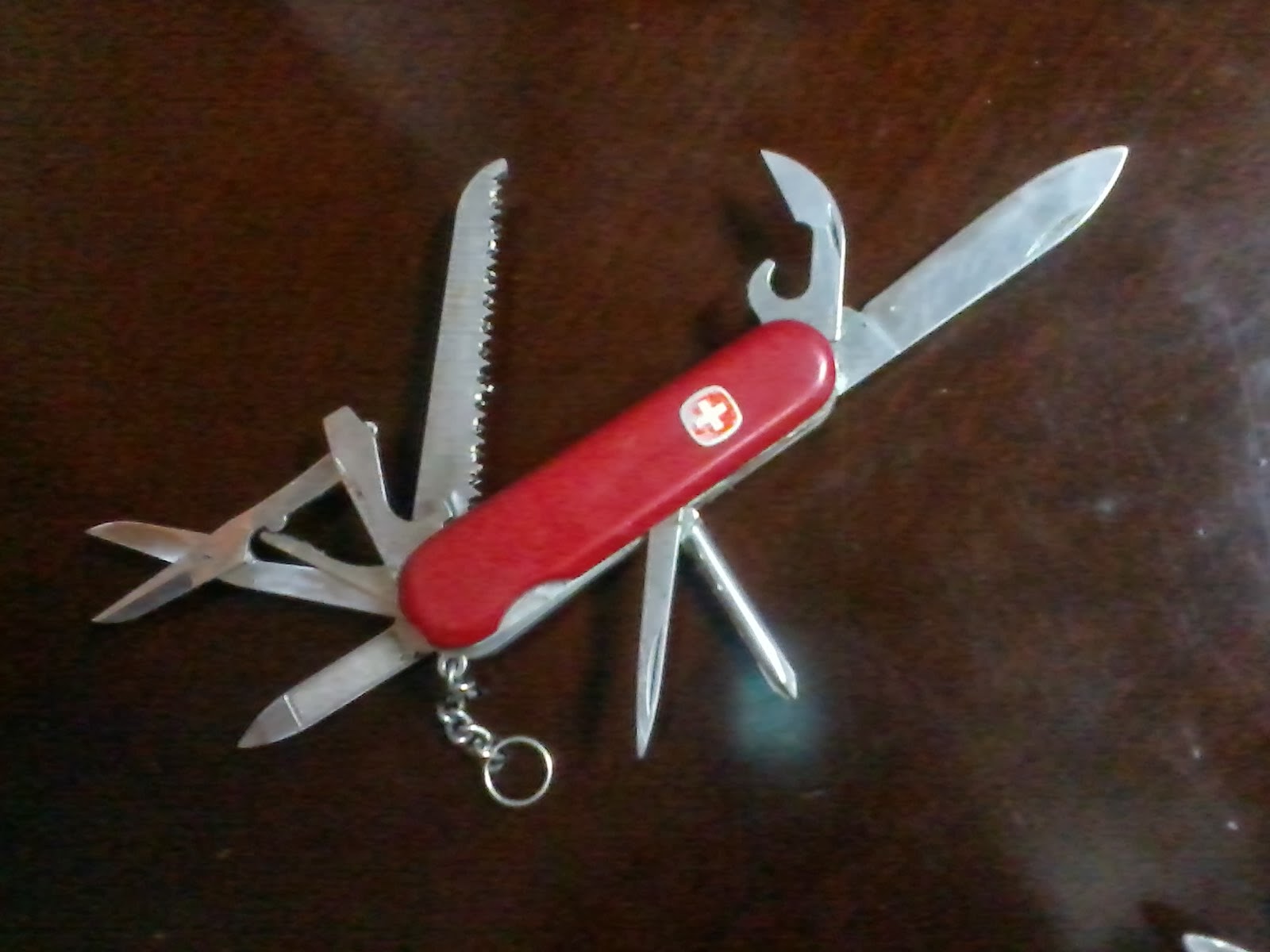
This was my traveling knife prior to 9/11/01. I would hook my keys to it, and it would go
right through security. No airplane – no
American airplane will ever again be hijacked by terrorists with small knives
or boxcutters. Morons like John McCain
kept the Gestapo the TSA thugs from relaxing the ban on small folding
knives last year. I still can’t carry something
convenient and sensible onto a commercial plane because politicians are more
concerned about perceptions than reality.
Ah, well, I avoid flying as much as possible anyway. That’s just one more reason.
That saw blade on the Wenger has seen a lot of use. Prior to acquiring that knife, when I went
camping or on a float trip, I carried a fixed blade knife big enough to use as
a chopper. If I couldn’t find enough
dead wood or driftwood, I’d hack into a snag or chop off some branches. The Wenger provides a quieter
alternative. Naturally, I’m still going
to carry a bigger knife because that’s the way I am, but it will get less of a
workout. I have used the saw blade for a
variety of pruning and even small woodworking chores. It even served occasionally when we built our
house ten years ago. I did the tile and
trim work myself, and, rather than go back to the jigsaw or chop saw, I would
sometimes do a little finish fitting with the SAK.

I do have a Victorinox.
While it lacks the saw blade, it also lacks the corkscrew. Like the Wenger, it has scissors. I use those quite often. The smaller knife blade on the Victorinox
pulls a lot of light utility duty. The
larger blade on both the Victorinox and the Wenger is easy to sharpen and keep
sharp. They are good for skinning and
dressing small game. I’ve used them to clean
fish. They would, I’m sure, be adequate
for skinning out a deer – I’ve done it with a stockman. I’ve also used these knives to clean and
prep vegetables from the garden.

When it comes to multi-tools, I still like the plus-plier
versions I have – the Gerber and especially the Leatherman Wave. I can drop those in my pocket, but they
usually go on my belt. Still the SAK offers
a great deal of multi-tool functionality in a lighter, smoother, slimmer
package. A belt-carried multi-tool looks
a little funny when someone is all dressed up.
Though they are fine for engineers, even software engineers, at work,
they might be a little much when we go to church. Depends on the church, I guess.
One of these days, if I happen to run across a Victorinox
Fieldmaster, I might pick it up. It has
all the same tools as my knife above, plus a saw blade. That would pretty well be the perfect SAK, as
far as I’m concerned. And that’s really
the nice thing about SAKs these days – you can get what you need.
Thursday, January 2, 2014
The Heat Is (Not) On
Down in Sydney, Australia, a few days past the summer solstice, it's hot. So scientists are saying that the climate is warming faster than feared.
I'm up to 14 degrees Fahrenheit during the coldest winter in the last ten years after one of the coolest summers in probably forty years. I'm not really worried about an ice age -- after all, it's winter, and summer before last was very hot and dry. The thing is that weather varies a lot, and scientists can get by with making ridiculous statements because people don't pay much attention:
Really? Where I come from, we have a word for this, but I'll substitute "making crap up as they go along." According to these geniuses, it could be that water vapor which evaporates from large bodies of water -- like oceans -- might rise only a short distance into the atmosphere creating updrafts which, I suppose, would dissipate the clouds. Because, you know, clouds are really sensitive to wind and water vapor:
I'm up to 14 degrees Fahrenheit during the coldest winter in the last ten years after one of the coolest summers in probably forty years. I'm not really worried about an ice age -- after all, it's winter, and summer before last was very hot and dry. The thing is that weather varies a lot, and scientists can get by with making ridiculous statements because people don't pay much attention:
”The net effect of [climate change] is you have less cloud cover.”
Really? Where I come from, we have a word for this, but I'll substitute "making crap up as they go along." According to these geniuses, it could be that water vapor which evaporates from large bodies of water -- like oceans -- might rise only a short distance into the atmosphere creating updrafts which, I suppose, would dissipate the clouds. Because, you know, clouds are really sensitive to wind and water vapor:
The optimistic models did not properly assess the impact of water evaporation, which sometimes rises only a short distance into the atmosphere and causes updraughts that reduce cloud cover, the study found.Just in case you think I made that up as I went along. Somebody might want to tell Science! that clouds are water vapor and tend to form under lower atmospheric pressure, which has little to do with updrafts or downdrafts. I suspect bank drafts.
Of course, it doesn't matter whether you use optimistic or pessimistic models because both are vastly overestimating the actual observed temperature changes. The average of multiple models projects an increase of around 0.75 degrees C, while the actual observed increase is closer to 0.2, or half a degree less, and slightly less than the most optimistic of models. There was a slight rise up in global temperatures during the late '90s, especially as measured by satellite data which came close to the model average at the time of a 0.25 degree increase. The only time the temperature has exceeded the modeled average was back in the late '70s. After the '90s, the models all project a rapid increase in global temperature averages to exceed a full degree C by the end of this decade. It is not going to happen.
The mean "normal" global temperature is said to be 57 degrees F. That is rarely the actual average -- as would be expected. The temperature is usually a little above or a little below that. Sometimes, as in 1100 BC, it is as much as two or three degrees higher; other times, like 200 BC and the Little Ice Age around 1600 AD, it may be a couple of degrees cooler. The mean in 1607 AD was down around 54.3 degrees.
Of course, none of this stuff is exact. They are all estimates, but the same data is available to everybody. It's just that some of us (scientists) get more research grant money when global warming is big in the news, and the rest of us get shafted by escalating electrical rates as coal-fueled power plants are shut down and denied permits.
If the rest of us were caught in such fraud and extortion, we'd probably go to jail.
Monday, December 23, 2013
A New Varminter
I didn't intend to post anything, but the weather has been too cold for riding, and I am kind of keeping an eye on a project that is wrapping up. My part should be done. I'm just trying to make sure that nothing on my side holds up the rest of the team.
While I'm waiting to get out on the bike, I loaded up some ammunition. A while back I mentioned the versatility of the .44 Remington Magnum. One of the loads to which I referred was using Hodgdon H110 and 180-grain hollow points, like the Sierras pictured below.

The load data from Hodgdon lists a 29.0 grain load of H110 under a Hornady XTP 180-grain bullet at a little over 1700 feet per second. It's fairly low pressure and gives the skittish loader such as myself a little breathing room. It's a pretty full case which often suggests consistency and thus accuracy.
So far, that seems to be working out. H110 is not a terribly fast powder. It lies closer to the median than the top in terms of relative burn rate, and Hodgdon classes it as a medium duty/magnum powder.
REMEMBER: Never trust anybody's load data, especially what you see on the internet. This works fine in my revolver, but if you blow yourself or your weapon up, don't blame me.
Anyway, I loaded up some of those Sierra HPs and tried them out. I have never used anything except 240-grain bullets in my Super Blackhawk because it has always shot them to point of aim, and, if something works amazingly well, I'm reluctant to change. Obviously, adding 400 or so fps with a lighter bullet means flatter shooting.
I have been loading Blue Dot and 2400 under my 240-grains. The recoil is "sharper", I think, with the heavier charge. I feel like I'm getting more muzzle lift, but, if that's the case, it comes later since the SBH is throwing the 180-grains low. That's not unusual for handguns. It gave an excellent 25-yard group. I haven't had a chance to try longer ranges and side-by-side comparisons with my 240-grain loads, but it does look like I have a new varmint gun.

I hope everybody has a Merry Christmas.
While I'm waiting to get out on the bike, I loaded up some ammunition. A while back I mentioned the versatility of the .44 Remington Magnum. One of the loads to which I referred was using Hodgdon H110 and 180-grain hollow points, like the Sierras pictured below.

The load data from Hodgdon lists a 29.0 grain load of H110 under a Hornady XTP 180-grain bullet at a little over 1700 feet per second. It's fairly low pressure and gives the skittish loader such as myself a little breathing room. It's a pretty full case which often suggests consistency and thus accuracy.
So far, that seems to be working out. H110 is not a terribly fast powder. It lies closer to the median than the top in terms of relative burn rate, and Hodgdon classes it as a medium duty/magnum powder.
REMEMBER: Never trust anybody's load data, especially what you see on the internet. This works fine in my revolver, but if you blow yourself or your weapon up, don't blame me.
Anyway, I loaded up some of those Sierra HPs and tried them out. I have never used anything except 240-grain bullets in my Super Blackhawk because it has always shot them to point of aim, and, if something works amazingly well, I'm reluctant to change. Obviously, adding 400 or so fps with a lighter bullet means flatter shooting.
I have been loading Blue Dot and 2400 under my 240-grains. The recoil is "sharper", I think, with the heavier charge. I feel like I'm getting more muzzle lift, but, if that's the case, it comes later since the SBH is throwing the 180-grains low. That's not unusual for handguns. It gave an excellent 25-yard group. I haven't had a chance to try longer ranges and side-by-side comparisons with my 240-grain loads, but it does look like I have a new varmint gun.

I hope everybody has a Merry Christmas.

Tuesday, December 17, 2013
NSA Uncovers Plot to Destroy U.S Economy
They found out about Quantative Easing? They realized we'll double the debt by the end of Obama term? They read Paul Ryan's budget?
No, this is a foreign plot -- possibly by the Chinese -- to attack the BIOS of computers. So we're even outsourcing the destruction of our economy to China. That's just great.
No, this is a foreign plot -- possibly by the Chinese -- to attack the BIOS of computers. So we're even outsourcing the destruction of our economy to China. That's just great.
Monday, December 16, 2013
Stopping A Bad Man With A Gun
Early reports on any event are always to be taken with some skepticism. However, Human Events discusses what may be some inconvenient facts about the little punk who shot an innocent girl in the face in Arapahoe High School last Friday.
The cowardly and privileged leftist turned the gun on himself when he realized he was about to be confronted with an armed opponent. The more good people we have who are armed, the fewer of these incidents we will have.
It is worth noting that the original mass shooter, Charles Whitman of Texas Tower infamy, killed 17 people but would have killed many more had he not come under fire from armed civilians as well as police. I use Whitman's name in opposition to my usual policy both because of the historical significance as well as the fact that Whitman suffered from a brain tumor which he tried to self-medicate. He was still an inexcusable monster, but one can understand that his thinking and brain function were severely disrupted.
In this latest case at Arapahoe High School, an armed Arapahoe County Deputy Sheriff, serving as school resource officer ran to the scene, shouting for people to get down and identifying himself as a deputy. The perpetrator knew he was coming and ended his brief, 80-second rampage by blowing off his own head with a Joe Biden-approved, legally-purchased shotgun.
When the NRA suggested employing armed guards to curtail school shootings, we were subjected to rabid, irrational attacks and mockery. We were right.
In this case, the shooter was upset that he had been disciplined and/or removed from the high school debate team. He was an argumentative person who, like many over-privileged, spoiled brats, had to triumph in every discussion. He mocked Republicans, supported stricter gun control (except for himself, like most leftists), believed in Keynesian economics, and advocated for socialism. A fellow student described the punk as a Marxist.
Again, these are from early reports and gleanings from the wussy little pervert's Fakebook page. We may learn more or find contradictions as time passes. Meanwhile, the lesson of having guns in the right hands is vindicated once more.
The cowardly and privileged leftist turned the gun on himself when he realized he was about to be confronted with an armed opponent. The more good people we have who are armed, the fewer of these incidents we will have.
It is worth noting that the original mass shooter, Charles Whitman of Texas Tower infamy, killed 17 people but would have killed many more had he not come under fire from armed civilians as well as police. I use Whitman's name in opposition to my usual policy both because of the historical significance as well as the fact that Whitman suffered from a brain tumor which he tried to self-medicate. He was still an inexcusable monster, but one can understand that his thinking and brain function were severely disrupted.
In this latest case at Arapahoe High School, an armed Arapahoe County Deputy Sheriff, serving as school resource officer ran to the scene, shouting for people to get down and identifying himself as a deputy. The perpetrator knew he was coming and ended his brief, 80-second rampage by blowing off his own head with a Joe Biden-approved, legally-purchased shotgun.
When the NRA suggested employing armed guards to curtail school shootings, we were subjected to rabid, irrational attacks and mockery. We were right.
In this case, the shooter was upset that he had been disciplined and/or removed from the high school debate team. He was an argumentative person who, like many over-privileged, spoiled brats, had to triumph in every discussion. He mocked Republicans, supported stricter gun control (except for himself, like most leftists), believed in Keynesian economics, and advocated for socialism. A fellow student described the punk as a Marxist.
Again, these are from early reports and gleanings from the wussy little pervert's Fakebook page. We may learn more or find contradictions as time passes. Meanwhile, the lesson of having guns in the right hands is vindicated once more.
Friday, December 13, 2013
Philipp Bagus on Paper Money
Specifically, Bagus speculates on how the experiment may end. He lists seven possibilities: inflation, entitlement default, debt repudiation, financial repression (legislatively "encouraging" the purchase of bonds), paying off of debt, currency reform, and a "bail-in" where savers become bank shareholders as in Cyprus.
He explains the crux of the problem:
h/t The Circle Bastiat
He explains the crux of the problem:
We are now in a situation that looks like a dead end for the paper money system. After the last cycle, governments have bailed out malinvestments in the private sector and boosted their public welfare spending. Deficits and debts skyrocketed. Central banks printed money to buy public debts (or accept them as collateral in loans to the banking system) in unprecedented amounts. Interest rates were cut close to zero. Deficits remain large. No substantial real growth is in sight. At the same time banking systems and other financial players sit on large piles of public debt. A public default would immediately trigger the bankruptcy of the banking sector. Raising interest rates to more realistic levels or selling the assets purchased by the central bank would put into jeopardy the solvency of the banking sector, highly indebted companies, and the government. It looks like even the slowing down of money printing (now called “QE tapering”) could trigger a bankruptcy spiral. A drastic reduction of government spending and deficits does not seem very likely either, given the incentives for politicians in democracies.Read the whole thing.
h/t The Circle Bastiat
Subscribe to:
Posts (Atom)